
Eyelid
Chalazion
Treatment of eyelid cysts — chalazion and hordeolum (stye) — with warm compresses, intralesional steroid injection, and incision and curettage (I&C).
Medically reviewed by Tamara R. Fountain, MDOculoplastic SurgeonLast updated June 2026
Part of our complete guide to Eyelid & Orbital Infections — this page covers chalazion and stye in depth.
What is a Chalazion
A chalazion is a chronic, sterile lipogranulomatous cyst that forms within the eyelid from obstruction and subsequent rupture of a meibomian gland. When meibomian gland secretions become inspissated (thickened) and cannot drain normally through the gland orifice, the gland ruptures internally, releasing lipid material into surrounding eyelid tissue. The body's immune response to this foreign lipid produces a granulomatous inflammatory reaction — the chalazion.
Chalazion is a benign eyelid lesion — part of the broader spectrum of eyelid skin tumors. See Benign Eyelid Lesions within the Skin Tumors section for related conditions including xanthelasma, molluscum contagiosum, and papilloma. Chalazia are closely linked to Blepharitis and MGD; recurrent chalazia warrant evaluation for Rosacea and — in older patients — biopsy to exclude sebaceous cell carcinoma.
Chalazion vs. Hordeolum (Stye)
These two common eyelid lesions are frequently confused:
Chalazion
- Sterile — no bacterial infection
- Meibomian gland origin (mid-eyelid)
- Painless or mildly tender
- Firm, round nodule within the eyelid
- Develops over days to weeks
- No spontaneous discharge
- Treated with warm compresses, steroids, or I&C
Hordeolum (Stye)
- Infected — bacterial (usually Staphylococcus)
- External: lash follicle (Zeis/Moll glands)
- Internal: meibomian gland abscess
- Acutely painful, red, swollen
- May spontaneously drain (pointing)
- Treated with warm compresses, antibiotics
- Most resolve in 1–2 weeks
Presentation & Diagnosis
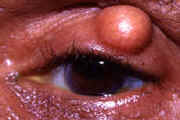
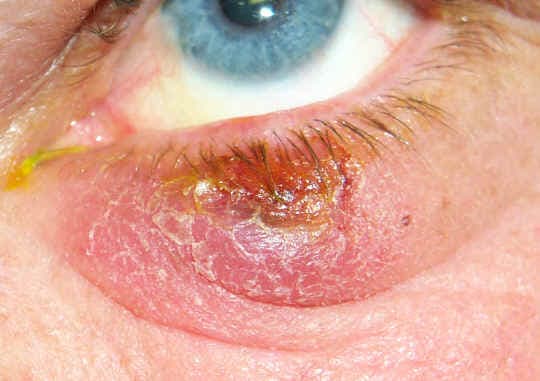
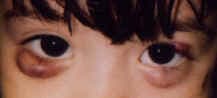
A chalazion presents as a painless or mildly tender firm nodule within the upper or lower eyelid, typically in the mid-lid away from the margin (distinguishing it from the margin-based stye). The overlying skin is normally mobile. On everting the eyelid, a localized, yellowish or pale elevation of the tarsal conjunctiva is seen at the site of the involved meibomian gland.
Large chalazia may:
- Distort the corneal surface, producing astigmatism and blurred vision
- Cause mechanical ptosis from the weight of the swelling
- Point through the conjunctival surface (internal) or, rarely, through the skin (external) and spontaneously discharge
- Cause significant cosmetic concern from lid contour distortion
When to suspect something else: A lesion that recurs in the same location after proper treatment, is accompanied by loss of eyelashes, or has an atypical appearance (irregular, firm, non-mobile) should be biopsied. Sebaceous cell carcinoma — a malignant tumor of meibomian glands — can masquerade as a recurrent chalazion and carries significant morbidity if diagnosis is delayed.
Treatment Options
Conservative Management
Many chalazia resolve with conservative treatment, particularly early lesions:
- Warm compresses: Applied for 5–10 minutes, 3–4 times daily. Heat liquefies inspissated lipid, facilitating natural drainage. Most effective in chalazia less than 4 weeks old.
- Lid massage: After warming, gentle massage along the lid margin may aid drainage.
- Treating underlying blepharitis: Concurrent lid hygiene, lid scrubs, and treating MGD reduces the rate of chalazion recurrence.
Intralesional Corticosteroid Injection
Injection of triamcinolone acetonide (0.05–0.2 mL of 10–40 mg/mL) directly into the chalazion is an effective office treatment with resolution rates of 50–80%, avoiding surgery. The injection may be administered transconjunctivally (through the everted eyelid) or transcutaneously (through the eyelid skin).
- Effect begins within 1–2 weeks; a second injection may be given if incomplete resolution occurs
- Generally well-tolerated; risks include transient local discomfort, skin depigmentation (particularly in darker skin tones — prefer transconjunctival injection in these patients), and very rarely globe perforation or — exceedingly rarely — retinal vascular occlusion from inadvertent intravascular injection, which can cause permanent vision loss if performed without adequate attention to anatomy
- Preferred over I&C for many patients due to avoidance of an incision
Incision and Curettage (I&C)
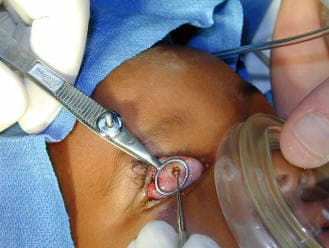
Incision and curettage is the definitive surgical treatment for chalazia that fail conservative management or intralesional steroid injection. The procedure is performed in clinic under local anesthesia:
- Topical anesthesia drops applied; local anesthetic injected into the eyelid
- A chalazion clamp is applied to the eyelid to stabilize and evert the lid
- A vertical incision is made through the tarsal conjunctiva over the lesion (transconjunctival approach — no visible skin incision)
- The granulomatous contents are curetted (scooped out) and the walls of the cyst are gently disrupted
- No sutures are required; the incision heals spontaneously
Resolution is achieved in >90% of cases. Recurrence at the same site after proper I&C should prompt biopsy to exclude sebaceous cell carcinoma.
Recurrent Chalazia
Patients who develop multiple chalazia or experience rapid recurrence after treatment should be evaluated for:
- Meibomian gland dysfunction and posterior blepharitis — the root cause in most cases. Aggressive lid hygiene, warm compresses, and oral doxycycline reduce recurrence rates.
- Rosacea — a common systemic predisposing condition; oral tetracyclines and facial skin treatment address both.
- Sebaceous cell carcinoma — any lesion recurring in the same location after adequate I&C must be biopsied. Sebaceous cell carcinoma is the great masquerader of the eyelid.
- Demodex infestation — treat with appropriate lid scrubs or XDEMVY.
Children with chalazia should be evaluated for staphylococcal lid disease and treated with conservative management first; I&C in children often requires general anesthesia.
Ready to discuss Chalazion?
Schedule a consultation with Tamara R. Fountain, MD to learn if this procedure is right for you.